By Steve Weisman
For the past several years, there have been many exotic/invasive species that have threatened our Iowa Great Lakes. In just the past two weeks, we have taken two gut punches back-to-back!
Gut punch #1: July 26, 2026
The first one was the discovery and treatment of Eurasian watermilfoil in Miller’s Bay canal located south of Miller’s Bay. In visiting with Andrew Carlson, Iowa DNR Fisheries Biologist, DNR personnel were able to control the highly invasive plant. No other outbreaks were found in West Okoboji and the rest of the chain of lakes.
However, we do know that Eurasian watermilfoil was first detected in August of 2022 on both East Okoboji and the lower chain. A huge eradication effort took care of that outbreak.
Then in 2023, Eurasian watermilfoil appeared in the canals of West Lake Okoboji. Once again, there was a quick response. Unfortunately, this invasive plant always seems to be lurking trying to get a toehold on our lakes. Thankfully, the Iowa DNR Aquatic Plant Management team monitors the vegetation throughout the year and treats the lakes with effective control methods as needed.
Gut punch #2: August 11, 2026
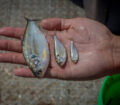
This one just came out: gizzard shad! While they are native to the Little Sioux River drainage to the south of the Iowa Great Lakes, until the last few years, they had never been a part of the Iowa Great Lakes system. Gizzard shad were originally found in East Okoboji on August 11, 2017, by Iowa DNR fisheries biologists during one of their routine fish sampling events. A total of 26 gizzard shad ranging from 3-5 inches in length were found. At that point, there seemed to be little concern because during normal, harsh northwest Iowa winters, they simply could not survive. Then we began to have milder and milder winters, and after the flood of 2024, I began to hear stories about them being in our lakes.
I had heard rumors last fall of anglers running into schools of small gizzard shad using their electronics. Now, according to Andrew Carlson, Iowa DNR Fisheries Biologist, an August sampling found an uptick in population numbers, highlighted by the collection of 1 adult, 23 subadults, and 1,846 young-of-the-year fish on the north end of East Okoboji Lake in a single 500-foot seine haul, confirming successful natural reproduction within the system.
Carlson notes, “After detecting higher numbers of gizzard shad across Spirit Lake and the Okoboji chain, we are closely monitoring the local population to understand how this species may fit into the food web. It’s too early to draw conclusions about how these fish will interact with the local aquatic ecosystem.”
The exact ecological impacts of gizzard shad in the Iowa Great Lakes remain unknown. In some systems, young-of-the-year shad provide an additional food source for popular game fish like walleye and yellow perch.
In smaller southern Iowa lakes, adult gizzard shad have severely harmed fisheries because they multiply rapidly and outcompete desired game fish such as bluegill, crappie and largemouth bass for food like zooplankton, along with reducing water quality.
“Because the Iowa Great Lakes sit at the northern edge of their range, harsh winter conditions often naturally limit gizzard shad survival,” said Carlson. “Continued monitoring is vital to evaluate if these fish can regularly overwinter and establish a long-term, self-sustaining population.”
In northern glacial lakes, sustained water temperatures below 36 degrees or ice cover exceeding 100 days often result in significant winter kills of both juvenile and adult shad, preventing long-term population growth. Iowa DNR Fisheries teams will continue regular fisheries sampling across the Iowa Great Lakes to track dynamics of forage fish, game fish, and other species.
Over the years
Zebra Mussels: 2012
Zebra mussels were first discovered in the Iowa Great Lakes chain in the fall of 2012, initially appearing in East Lake Okoboji and Upper Gar on boat hoists and docks. By the fall of 2015, zebra mussels had spread throughout the Okoboji chain. Then in September of 2017, zebra mussels were confirmed on Big Spirit Lake.
These D-shaped clams have alternating light and dark bands or stripes. Most are less than one inch long. They are filter feeders that can form dense clusters as they attach to hard underwater surfaces. In the case of large infestations, they may interfere with aquatic food webs, kill native mussels, clog water intakes, increase algae blooms, and cover beaches with dead shells. Young zebra mussels are microscopic and can be unintentionally transported with water in bilges, live wells or bait buckets. Adult zebra mussels can attach to boats, trailers and aquatic vegetation.
Unfortunately, there is no known way to eliminate this species. The impacts of zebra mussels are still evolving, and it could be years before all of the impacts are truly known. However, zebra mussel populations and their ecological and socioeconomic effects have been known to plateau and even decline over time.
Asian Carp: 2011
Back in August of 2011, while fisheries biologists were collecting data on the fish in the Okoboji chain, they discovered two bighead carp that were between 14 and 16 inches in length. The next spring a commercial fishing crew netted 82 bighead carp and 55 silver carp in the same area. These fish were able to fight their way up the Little Sioux River during high water events.
A major concern regarding whether these fish could ever reproduce in the Iowa Great lakes. Thank goodness the answer is most likely not. Asian carp eggs need the flow of a river as they develop. The eggs are neutrally buoyant, meaning they neither float nor sink. If they don’t have that flow, the eggs will settle out to the bottom and get covered up by sediment.
The Iowa DNR determined that an electric fish barrier would be the best bet to stop this type of migration into the Okobojis. A barrier was installed in the fall of 2012.
There are probably some individual fish still in the system.
Yellow Bass: 2005
In 2005, yellow bass were found in East Okoboji and are now prevalent throughout the Okoboji chain of lakes. They have been around for over 20 years, and many anglers do not realize there are a non-native species in the Iowa Great Lakes.
Yellow bass were most likely introduced by anglers. Unfortunately, as a non-native species, the yellow bass may have the ability to upset the balance in a lake as they compete for food and resources. However, if a fishery and lake is healthy, it may be resilient enough to absorb the species without causing too much harm. Biologists believe that is what has happened in the Iowa Great Lakes.
Curly-Leaf Pondweed: 1950’s
Check out the north end of East Okoboji Lake in May, and you can’t miss it! Curly-leaf pondweed, an invasive, submersed aquatic plant, has been around since the 1950’s. Although it has been in the Iowa Great Lakes for over 70 years, it brought little concern until the late 1980s, when DNR fisheries biologists noted there was dense growth beginning to appear on the north end of East Okoboji.
Then the curly-leaf explosion occurred beginning in 2011. Consecutive mild winters, lower water levels, light snow cover and clearer water combined with sunlight to trigger massive surface densities. Since that time local associations and the Iowa DNR have coordinated mechanical harvesting and targeted strategic herbicide treatments to help manage the curly-leaf explosion. However, the applications only take care of that year’s growth. It dies back by mid-summer, but then it begins the next generation under the ice. It often spreads to other areas from broken stems and plant pieces – often caused by boat/motor traffic, trailers and livewells.
It ain’t over till it’s over
Yogi Berra, former New York Yankee great, made this quote famous. That is my challenge to all of us now! “It ain’t over!” I truly believe that we still can succeed. We have strong individuals, non-profit organizations and biologists who are not going to give up. We just flat out need to do better. We need to take ourselves out of the equation of being the problem. We need to clean, drain and dry…it is no joke! We need to work together with what we have and STOP the SPREAD of all invasives!
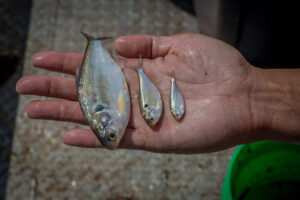
(photo courtesy Iowa DNR-Wikimedia Commons) – Three different sizes of small gizzard
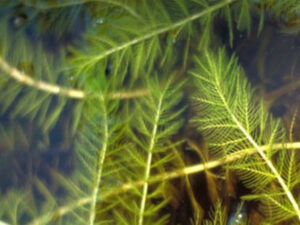
(photo courtesy Iowa DNR) – Eurasian watermilfoil.