
By Steve Weisman
This past Thursday, August 6 was an important day for both lake homeowners on West Okoboji’s Pillsbury Point and the general public wanting to know more about the anticipated shoreline restoration project. The Iowa Department of Natural Resources (DNR) hosted a pair of informational meetings with a total of 54 people attending the meetings.
The meeting for the general public was held Thursday evening at the Maser Monarch Lodge in Okoboji. Mike Hawkins, NW Regional Fisheries Management Supervisor, and one of the lead officials working on shoreline devastation caused by the June flood of 2024, conducted the meeting, which was a mix of a slide presentation followed by public input and question/answer session.
Background on Pillsbury Point
Pillsbury Point is the point just west of the Arnolds Park Amusement Park, the smallest state park in Iowa at 6.48 acres. It is officially designated as an urban park and extends along a point of land out to the very point.
Back to the south of the point is the Abby Gardner cabin and museum, which was the location of the Spirit Lake massacre in 1857. It was donated to the state of Iowa in 1928 to ensure its preservation.
During the 1930s, the Civilian Conservation Corp (CCC) constructed walkways along the lake, stone steps, stone benches, and property boundary markers. In 1934, Pillsbury Point was re-designated as a state preserve, designed to protect areas of historic or scientific interest rather than recreational purposes. It was put under the jurisdiction of Gull Point State Park in 1936.
In 1940 it was reclassified again as a historic-archaeological park based on the National Park Service’s system. The overlook at the north end of the park was listed on the National Register of Historic Places in 1990.
Results of the flood: a look at Pillsbury Point
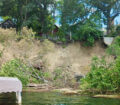
Hawkins noted, “Following the 2024 flooding, a total of 22 counties across northern Iowa were declared disaster areas with a total of 1 billion dollars in damage. It was a stressful time for so many people.” The flooding caused a total of 78 bank collapses affecting 2,700 feet of private shoreline and another 585 feet of public shoreline issues. This included seven segments at Pillsbury Point.
Bolton and Menk Engineering and Braun Intertec, a geotechnical firm, was contracted to address slope stability of the point and make recommendations for repair and long-term management and to design the project. According to the engineers, most banks around Pillsbury Point are 20’ to 30’ high and have very steep slopes. Analysis showed that over 64% of the 1,200 feet of shoreline on Pillsbury Point continues to be an urgent or high-risk level of future bank collapse.
The firm’s recommendation to address this issue revolves around the complexities of stabilizing the entire point: addressing the slopes, removing unwanted vegetation and trees, followed by establishing deep rooted native vegetation and preserving the historic infrastructure of Pillsbury State Park.
Much of the shoreline will be repaired by rebuilding the slope and armoring the base, but there are several areas where the shoreline will be too steep and will require more advanced engineering solutions. These include:
- Geotechnical webbing-3D honeycomb network that locks soil in place.
- Soil nail-steel reinforcement bars inserted into unstable slopes and grouted in place.
Even with these advanced techniques, the finished product will still look natural with the deep roots of native grasses and flowers doing much of the work to hold the soil.
Getting approval
With survey, design, engineering, permitting, bidding, and public meetings completed, the DNR staff will present the project to the Natural Resources Commission (NRC), the seven-person citizen commission that provides policy oversight including overseeing state wildlife rules, land acquisitions and budgets. The NRC meets on Thursday, August 13, and the Pillsbury Point shoreline restoration plan and budget is on the agenda. Funding for the Pillsbury Shore Restoration project is a combination of the Iowa Lake Restoration Funds and Marine Fuel Tax Funds. The hope, obviously, is that the $3.1 million project will be approved.
Pillsbury Point Timeline
This entire process has been ongoing since 2024, beginning with the aftermath and initial assessments to selection of an engineering firm to provide survey, design, and engineering, permitting and finally bid letting.
Construction is scheduled to begin October 1st. All of the work will be done from the water since access from the top of the bank is limited and care must be taken to protect historical structures at the top of the bank. As a result, a staging area will be needed to hold equipment and products used in restoration.
The staging area will be along the shores of Gull Point State Park with barges used to haul equipment and materials to Pillsbury Point. Boaters are encouraged to be cautious during this time. Hawkins adds, “Work will continue this fall until ice covers the lake. Then work will resume when the ice leaves in the spring. The hope is to have the restoration completed by September of 2027.”

(photo by Steve Weisman) 1a-Mike Hawkins, NW Regional Fisheries Management Supervisor shares an update at (photo by Steve Weisman) Thursday evening’s public meeting.
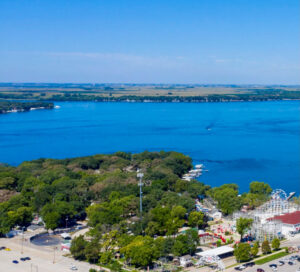
(Photo by Iowa DNR) #1b-Aerial view from the southeast of Pillsbury Point.
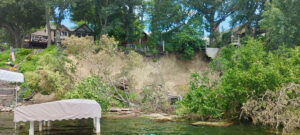
(Photo by Iowa DNR) One of the bank collapses on Pillsbury Point during the flood of 2024.
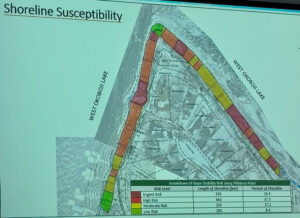
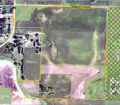
(Photo by Iowa DNR) Diagram of shoreline susceptibility on Pillsbury Point.
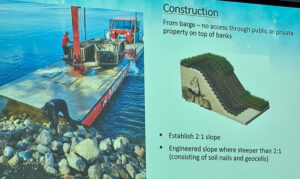
(Photo by Iowa DNR) Construction plan-from barge.