
By Steve Weisman
One excavator bucket at a time, the dredging of Turtle Lake has begun with work contracted with Superior Seawalls, Docks and dredging, which is located in Illinois City, IL directly across the Mississippi River from Muscatine, IA. They have completed dredging projects throughout the Midwest, including Iowa.
The process being used is called mechanical dredging, using heavy equipment like excavators and dredge barges to physically remove sediment (silt) from the lakebed. This method is suitable for larger sediment volumes and areas with easy access.
A little history
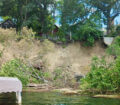
As mentioned in earlier articles, Turtle Lake was created in the early 1900s as a canal system connecting Millers Bay, Emerson Bay and Spencer Beach. Originally dredged in 1910, over the past 100+ years, sediment has accumulated to the point that now the lake is only a couple feet deep. This has decreased navigation and led to a silted in weed-choked system with poor water quality. In addition, over the years two original islands have simply disappeared and eroded into the water.
Over the past few years, a Save Turtle Lake Committee has been formed to restore the waterway to its original 6-8-foot depth, restore the shoreline, improve water quality and enhance the habitat for wildlife. Fundraising over the past year has secured the funding to dredge the main part of Turtle Lake from bridge to bridge.
According to Tim Ireland, a volunteer with the Save Turtle Lake committee, “It’s important to note that Turtle Lake is a full public access lake while most funding for this phase was provided by members of the Lakewood Park Association along with generous grants from the Sherwood Foundation and the Andrea Waitt Carlton Foundation. In addition, other lakes area community supporting organizations and individuals across the region played a meaningful role in helping to reach this milestone. The local community leadership and shared commitment to restoring the Turtle Lake waterways made this once-in-a-century project possible.”
The plans are based on sonar work to determine the exact depth of the sediment being taken out, how much the bottom will taper from the shoreline and the amount of riprap and native vegetation will be planted to protect the shoreline. As the buckets take out the sediment, each bucket has a mounted gps sonar that lets the operator know exactly the depth the bucket is at.
So, the work begins
According to Ireland, “The hope is the entire project will take two to two and a half months once they get going in the spring. This fall’s work is mostly preparatory with excavators set on shore along the southwest corner of the main body of water.”
This fall’s plan is to excavate down and remove enough sediment, so that there is a three-foot depth of water, which is enough depth for the steel floating barges to be able to move about the lake to handle an excavator and the dredged sediment. This is then taken back to the shoreline, where the load of sediment is then scooped by bucket into a big dump truck for removal to a county-owned gravel pit near Milford. The work this fall will stop when Turtle Lake becomes ice covered.
Next spring
Interested onlookers have questioned the minimal equipment being used this fall. That will change next spring. “Next spring is when the real work begins,” noted Ireland. “Superior Seawalls will bring in a lot more equipment with at least 5-6 dump trucks and floating barges.”
Cost for the excavating comes in at $21.50 per cubic yard, which is an amount based on when the planning began a few years ago. According to Ireland, “While that is costly, by today’s standards, bids are coming in between $32-$38 per cubic yard. It has really helped that our contractor is honoring the original price!”
Going for a complete restoration
So, what about the canals? Committee members and donors of the project are now looking at expanding the operation to include what’s known as Paddler’s Path and Wilderness Way. Yes, it will cost more money, but the cost of $21.50 per cubic feet will never be available again, and it would cost an additional $80,000 to bring the equipment back in the future.
With dredging operations for Turtle Lake itself being funded through grants and donations, committee members are hoping others will come forward to help out with the additional areas. The cost for dredging Paddler’s Path and Wilderness Way has been estimated at an additional $800,000.
Ireland, reflected, “Dredging Turtle Lake and the adjoining canals, Paddler’s Path and Wilderness Way, is about more than improving navigation—it’s about protecting the overall health of West Okoboji and the Wahpeton community. Yes, there is the additional cost, but we know how important Turtle Lake and its canals are to so many people. The canals are DNR-owned waterways, and by stepping up to help, our community is restoring water circulation, reducing stagnation, and creating cleaner habitats where fish, turtles and native wildlife can thrive. By investing in these dredging efforts, we are preserving recreational access and safeguarding a vibrant ecosystem for future generations.”
What a coup it would be if the entire project, not just Turtle Lake but also the canal system, could be completed at the same time.
Fundraising continues
Ireland concluded, “You can help us restore this essential ecosystem and recreational area by sending your tax-deductible donation in the form of check, IRA contribution or securities to the Okoboji Foundation, PO Box 593, Okoboji, IA 51355. Donations can be made at Okobojifoundation.org/giveboji/. Scroll down and select Save Turtle Lake. You can also call Mindy Gress with your Save Turtle Lake contribution at 712-332-7177. Please specify Save Turtle Lake.”
For more information or to join the committee, please contact us at save.turtle.lake@gmail.com.
(photos by Steve Weisman)

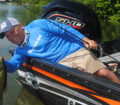
Another bucket of sediment goes into dump truck box.
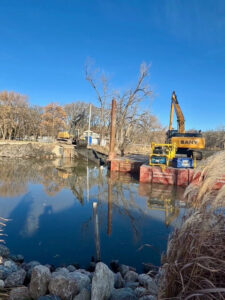
Equipment placed and ready to begin the fall initial dredging.
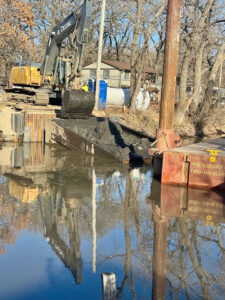
Excavator bucket scraping sediment from the barge.