
By Steve Weisman
Outdoor Editor
Iowa pheasant hunters get ready! The results of the annual August Roadside Count are in, and the data shows 2025 is set to be a record breaker…Iowa’s statewide pheasant population is at a 20 year high! A “tip-of-the-hat” goes out to the Iowa DNR Enforcement and Wildlife Bureau personnel for their efforts in collecting the data and for Todd Bogenschutz, upland wildlife research biologist, for putting all the data together in the report form.
Let’s take a look
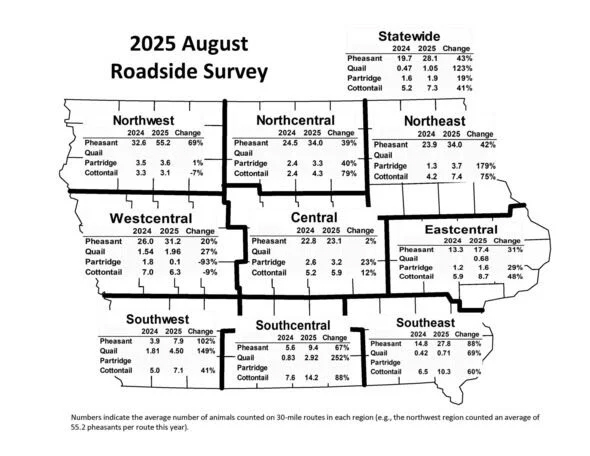
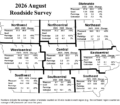
The statewide average of 28 birds per route is the highest since 2005. Regionally, the northwest region was the highest since 2005; northeast region was the highest since 1998; west central similar to last year; east central highest since 2007; south central highest since 2017; and southeast, highest since 2020.
According to Bogenschutz, “The mild winter really put us over the top this year. Our adult hen survival was excellent; our adult rooster survival was excellent. That really drove the population increase.”
As always, two factors are the main determiners in upland bird numbers: weather and habitat. It’s been that way forever, and it has been documented since the roadside counts began in 1962! For the ’25 hatch, Mother Nature was kind, and we experienced an extremely mild winter with the fourth least snowy winter in the past 138 years. That most certainly helped carry over more hen pheasants than normal.
The mild temperatures of March and April led to earlier than normal nesting. The accumulated rainfall during nesting for much of the state was less than eight inches, another positive.
By the numbers
All northern regions showed double digit increases from last year, along with significant increases in total hens and chicks compared to 2024. Counts in all three regions are above their 10-year averages.
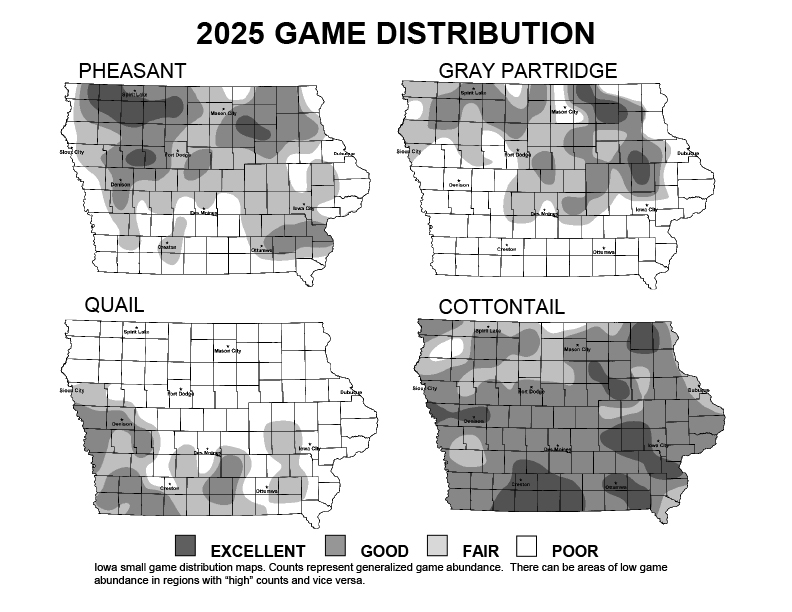
The NW region averaged 55 birds per route which was the highest density of any region in 2025, while the NE and NC regions averaged 34 birds/route, respectively. All three regions should offer good to excellent pheasant hunting, particularly around public and private lands with good winter habitat. Better counts in NW came from Clay, Emmet, Dickinson, Palo Alto and Osceola counties. One of the reasons northwest Iowa’s survey numbers are the best in the state is the amount of state and county lands managed for hunting.
Butler, Hancock and Kossuth counties reported better numbers in the NC region, while the NE region reported the best counts in Bremer, Chickasaw, Howard and Winneshiek counties.
The bonus bird: gray partridge
Unless you spy them first, a covey of gray partridge will explode in the air, and the resulting hunter shock often comes with a few wild shots and few birds bagged. The gray partridge prefer the wide-open and treeless agricultural lands of the northern two-thirds of the state. The NW, NC, NE, and C regions reported the best densities in 2025 all averaging 3 to 4 partridge/route. Better counts in 2025 came from Buchanan, Butler, Dickinson, Emmet, Fayette, Mitchell, O’Brien, and Palo Alto
Counties.
Data on quail
Iowa’s statewide bobwhite quail index more than doubled (+123%) from last year with 1.1 quail per route in 2025 compared to 0.47 quail per route in 2024, and brood sightings were also statistically
higher in 2025. This year’s statewide quail index is 15% above the 10-year average and just 19% below the long-term mean. This is Iowa’s highest statewide quail index since 2018. Similar to pheasants, the very mild winter likely led to excellent overwinter hen survival leading to large increases in breeding hens this spring and an excellent number of nests. Counts increased significantly in the SW and SC regions, while counts in the SE, WC, and EC regions also showed increases.
The SW region reported the best overall quail numbers in 2025. Better counts in 2025 came from Audubon, Harrison, Monona, Montgomery, Lucas, Taylor and Wayne counties. Hunters should focus quail hunting where there is a good mix of shrubs, ag fields, and weedy habitat.
About the August Roadside survey
Each year the Iowa Department of Natural Resources uses a roadside survey between August 1-15 to assess its upland game populations. For best results, the routes are conducted on sunny calm, mornings, with a heavy dew on the grass, which helps bring the hen pheasants and their broods to the roadsides to dry off before they begin feeding.
The 210-30-mile routes (6,300 miles across the state) are conducted entirely on gravel roads. Most counties have two routes, and the information from all of these routes is condensed to produce the survey document.
HABITAT, HABITAT, HABITAT
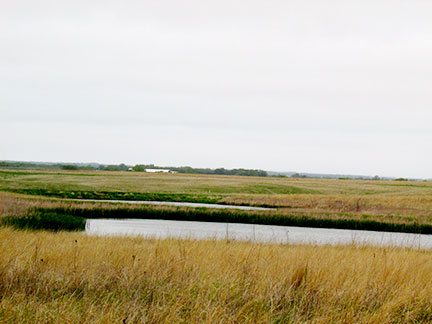
Mother Nature controls the weather, but WE control the habitat. The influence of habitat changes on upland populations are more gradual than the impacts of annual weather. The effects of habitat change are only evident after looking at multiple years of surveys. A positive factor in pheasant numbers has been the Conservation Reserve Program (CRP), which was established by Congress in 1985 with land first enrolled in Iowa 1986.
Information from the USDA shows, however, that between 1995 and 2025 Iowa has lost 2,942 square miles of potential pheasant habitat. As of June 2025, Iowa has 1.67 million acres enrolled, with 727,000 acres of Iowa’s entire enrollment expiring by fall of 2027. This equates to 44% of Iowa’s CRP in the next three years!
100-year celebration
It’s fitting that 2025 pheasant numbers are up with this year celebrating 100 years of pheasant hunting in Iowa. According to Bogenschultz, there is the potential for hunters to bag anywhere between 600,00 – 700,000 rooster pheasants! Many years, the early hunting is tougher because of the crops still in the field. However, with the potential for an early harvest, the October 25 opener could be outstanding!
The “youth-only” weekend, which is for Iowa residents only, age 15 or younger, is actually the weekend prior to the regular opener October 18-19. What a great opportunity for youngsters to get the first shot at a wily rooster.
We’ll discuss preparing for the season as we draw closer to the opener!