By Steve Weisman
Perch anglers been waiting for several years for a winter like this when the adult perch (9-11”) goes on a strong bite, and, yes, this winter seems to be the year. Since a good walking ice base was established well before Christmas, it’s been lights out with buckets of perch being taken. Towns have literally popped up where most of the action has been taking place. The key depth seems to be in the basin of the lake (18-20+’ of water) with the schools of perch feeding on blood worms in the mucky bottom.
In visiting with Mike Hawkins, Northwest Regional Fisheries Management Supervisor, blood worms are the red larval stage of the midge flies (Chironomidae family). “They are a natural part of Big Spirit’s ecosystem and are a primary food source for perch.”
For the most part, the bite has really been consistent with anglers not having to move great distances. It seems that once a school of perch finds its food source, the school will meander around that general area. In some instances, anglers have been able to take a limit of perch in two hours or less. However, that is the exception. It often takes persistence and if the fish aren’t showing up on your electronics after 15-20 minutes, it’s time to move. Often, that doesn’t mean across the lake, just maybe to the edge of the crowd you are fishing around.
Typical baits such as a spoon tipped with a minnow head or silver wigglers, a tungsten jig (like the Element 74 Jig) or a dead stick with a hook, splitshot and slip bobber and a live minnow. A bait that has been good for my group has been the gold Clam Tikka Flash. Don’t be surprised if you end up catching a nice walleye from time to time, especially early morning and late afternoon into evening.
Analyzing the perch life cycle
Ever since I moved to the Iowa Great Lakes in the late 1970s, I’ve witnessed the ups and downs of the perch fishery on Big Spirit Lake. Each year is different; each year the bite changes. Nothing seems to be more cyclical than the yellow perch. For those who chase the schools of perch, you know what I mean. It seems that there are more peaks and valleys than a hilly road!
According to Hawkins, biologists at the Spirit Lake Hatchery keep annual angler creel statistics, which better tell what happens on a yearly basis. Sometimes, to anglers, it seems to be either boom or bust and often there seems to be more bust. “This is typical of yellow perch. The up and down cycle is predictable with what we’ve seen ever since angler harvest has been tracked back to the 1950s.”
One of the dynamics of the perch population on Big Spirit Lake is that they are the main forage for most predator fish. Then add the fact that perch are cannibalistic predators of themselves. So, everything, including the big perch, makes a meal of those tiny perch. It is only when the oldest perch in the population comes to the end of their life cycle that a batch of young fish class has the chance to become the next big perch year class.
“A perch has a maximum life span of 5-6 years,” notes Hawkins. “We tend to see strong perch year classes every three to six years. It is interesting to note that if a year class is too large, then their growth slows, and they take longer to reach the angler catchable size. The bigger the year class, the fewer resources there are for each fish. “ Bottom line: a moderately sized year class tends to provide both good catch rates and more quality sized fish.
The first three years are the years of the most growth for perch. If things hold together, by year three, perch will have grown to be up to eight inches. If they get to that length by then, most likely a big year class of catchable/keepable perch will be on the horizon. The growth rate slows down after those first three years, thus the big perch will mostly be in the 10-11+ inch size. Of course, every once in a while it seems everything aligns perfectly and you have back to back-to-back good fishing years. I am hoping that 2025 and 2026 will be one of those up cycles.
Anglers typically give themselves too much credit for causing harm to a panfish fishery. It is highly unlikely anglers can impact the yellow perch population negatively on a lake the size of Big Spirit. Since the lifespan of perch is so short and their natural mortality rates are so high, if an angler doesn’t utilize them, they will die soon after.
The “up and down and up and down” cycle will continue its pendulum swing. It’s all up to the dynamics of the entire fishery as to when that will happen. It’s most important to take advantage of that up cycle like we are having right now on Big Spirit!
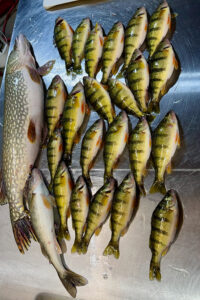
A nice mixed bag ready to be cleaned.
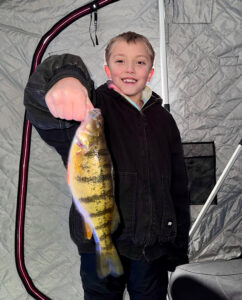
Nine-year-old George Hagedorn from Iowa City experienced ice fishing for the first time and was plenty proud of this 11”+ Big Spirit Lake perch.
Cutlines: (photos by Hunter Wheatley)
#1a-Nine-year-old George Hagedorn from Iowa City experienced ice fishing for the first time and was plenty proud of this 11”+ Big Spirit Lake perch.
#1b-A nice mixed bag ready to be cleaned.