By Steve Weisman
While late fall fishing and various hunting seasons continue taking place across the country, there’s something else also taking place. Yes, plans for ice fishing have been going on at ice fishing manufacturers and retail outlets since, well, the 2024 ice fishing season ended. With the potential of several days below freezing the first week of December, there is a chance we get ice fishing earlier than the past few years.
Getting ready
As an ice fisherman for 60+ years, preparing for the new ice season never gets old. I’ve learned the importance of getting ready plenty early. Before the season, it’s important to go through all the ice fishing gear to make sure everything is ready to go. When the first good ice appears, you don’t want to be scrambling haphazardly to get things ready.
Not all ice is created equal
I’ve said it before, and I will say it again and again and again: not all ice is created equal! Unfortunately, each ice season we can look back to several instances throughout the ice belt l where ice anglers had to be rescued from unsafe ice, even worse when a life or lives are lost because of questionable ice conditions.
Ice thickness will vary from spot to spot even on the same area of the lake and even from one day to the next and certainly from one lake to another.
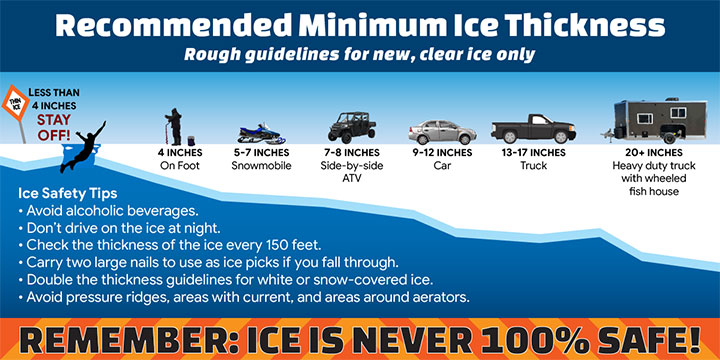
Each state across the northern Ice Belt puts out safety guidelines anglers can use when considering ice fishing. According to ice safety experts, stay off ice that is three inches or less in thickness. Four inches of solid, clear ice is the minimum to support one angler. Be careful of fishing alone in case something happens, but a group of anglers should not walk out together on four inches of ice. It’s wise to check ice depth as you move out deeper.
At the same time, there are other considerations. Watch out for bridge areas and other current areas, areas where water is entering the lake, shallow rocky areas or weedy areas. It seems every year here in the Iowa Great Lakes, vehicles break through, and thankfully, no one has perished. West Okoboji, East Okoboji and Big Spirit Lake are the worst! For some reason, they all develop seams and heaves, and the ice seems to move, creating other seams and heaves. The thin ice under the bridge between East and West Okoboji seems to be a magnet, and every year somebody foolishly thinks they can make it through. However, that hasn’t happened yet!
Close calls last winter
You might remember just how crazy and weird the ice conditions were across northwest Iowa last winter. Some areas never froze all season. That happened especially on the east side of Big Spirit Lake all the way from Big Stony Point all the way south to the Reeds Run area. There were also areas on West and East Okoboji that never froze over.
Just last winter during the Winter Games, multiple people were rescued on both West Okoboji and East Okoboji. Then in early February, a couple’s UTV went through the ice out off Bridges Bay/Waterfront Restaurant area and Kyle Peterson, an Iowa Great Lakes resident, looked out and saw what was happening. He called 911 and went out and actually rescued the couple.
At the same time, in early February, a fisherman was rescued on Big Spirit Lake by fire crews in the Buffalo Run area when the ice broke. Another brush with death.
My best advice is to check with area bait shops and area guides’ websites. They often have critical ice safety updates.
Remember, finally, snow on top of the ice slows down the freezing process, and you cannot see what’s going on beneath that snowpack.
Preparation
Before you go out, use common sense, and be prepared. Wear a life vest under your winter gear, or better yet wear one of the new flotation ice fishing suits such as the motion float technology designed by Clam Outdoors in its Ice Armor suits. It’s a good idea to carry a pair of ice picks if you do happen to break through. On clear ice, always use a good set of ice cleats to give a good grip as you pull out your shelter and equipment and most importantly to help avoid falls.
At my age, I’ve found it important to go light as possible when walking on the ice. I still like to have a shelter, so I’ve gone with the Clam Scout XT Thermal. At less than 50 pounds and with runners to help move the shelter, I can store a bucket with rods and tackle, heater, Vexilar and auger and still be relatively light and portable.
Here is one final thought from the Dickinson County Emergency Management’s website. “Check the thermometer, not the calendar. Air temperature and recent weather patterns can significantly impact ice quality. Just because the ice was safe on a certain date last year doesn’t mean it will be safe this year.”
Some cold facts about ice (taken from the Dickinson County Emergency Management website.
- You can’t judge ice conditions by appearance or thickness. Many other factors, including water depth, size of water body, water chemistry, currents, snow cover, age of ice, and local weather combine to determine its strength.
- New ice is usually stronger than old ice. Four inches of clear, newly formed ice may support one person on foot, while a foot or more of old, partially thawed ice may not.
- Ice seldom freezes uniformly. It may be a foot thick in one location and only an inch or two just a few feet away. Ice near shore can be weaker than ice farther out. Check ice thickness every 150 feet at a minimum.
- Ice formed over flowing water and currents is often dangerous. This is especially true near streams, springs, channels between lakes, bridges, culverts and aeration systems. Also, the ice on outside river bends is usually weaker due to the faster current.
- The insulating effect of snow slows down the freezing process. The extra weight of snow cover also reduces how much weight the ice sheet can support by approximately 50 percent.
- Booming and cracking ice isn’t necessarily dangerous. It may only mean that the ice is expanding and contracting as the temperature changes. However, watch for large cracks, depressions or pressure ridges in the ice and avoid those areas.
- Schools of rough fish or flocks of waterfowl can adversely affect the relative safety of ice. The movement of fish can bring warm water up from the bottom of the lake, and waterfowl can warm the surface of the ice. This activity can cause holes to open up, posing a threat to anyone traveling on the ice.
Yes, I am chomping at the bit! I can still remember years ago ice fishing in Anglers Bay the Friday after Thanksgiving. The potential for some good ice is coming, and with the way our northwest Iowa lakes produced a real variety of quality fish during the open water season, things are looking good for this winter…walleyes, northern pike, crappies, bluegills, perch and yellow bass. Enjoy, but above all be safe!
ice safety tips courtesy of the Minnesota Department of Natural Resources